If you are a founder or small business owner in 2026, your time is your most valuable asset. Yet, if you audit your typical workday, you will likely find that a shocking percentage of your time is consumed by repetitive, administrative labor. You are not alone. According to recent workforce studies, the average professional loses up to 28% of their workweek—roughly 13 hours—just managing their email inbox .
When you add data entry, scheduling, customer support, and content creation to the mix, it becomes clear why so many entrepreneurs suffer from burnout. The reality is that human beings were not designed to act as human routers, moving data from one spreadsheet to another.
The good news? The era of manual drudgery is over. Artificial intelligence has evolved from a novelty into a highly capable, autonomous workforce. By leveraging platforms like SmartPromptIQ, businesses can deploy AI agents to handle the repetitive work, allowing human talent to focus on strategy, relationship building, and creative problem-solving.
If you want to scale your business efficiently this year, here are the 7 tasks you should never do manually again.
1. CRM Data Entry and Lead Routing
Of all the manual tasks that drain a company’s resources, data entry is arguably the most damaging. According to a 2025 State of Sales report, the average sales representative spends 17% of their working hours manually entering data into CRM systems . Across a small team, this equates to thousands of hours of skilled labor wasted on typing.
Furthermore, manual data entry is inherently flawed. The accepted average error rate for manual entry is around 1% under normal conditions, but this can jump to 4.1% when employees are fatigued or rushed . These errors compound, leading to duplicate records, inaccurate forecasting, and delayed lead follow-ups.
The AI Solution:
Modern AI automation intercepts data at the point of origin—whether it is a web form, an email inquiry, or a scanned business card—and automatically populates your CRM. It validates the information, checks for duplicates, and routes the lead to the appropriate team member instantly. Businesses implementing automated data entry report an 80% reduction in administrative hours and a 90% drop in data errors .
2. Tier 1 Customer Support and Ticketing
Customer expectations have never been higher. They expect instant, accurate responses regardless of the time of day. Attempting to manage this manually means either paying for a 24/7 support team or constantly monitoring your inbox during your personal time.
The data shows that consumers are increasingly comfortable with automated assistance. In fact, enterprise adoption of AI chatbots has surged, with conversational AI projected to save businesses $80 billion in labor costs by 2026 .
The AI Solution:
Deploying an AI Customer Success Agent can handle up to 60% of routine inquiries—such as password resets, order tracking, and basic product questions—without human intervention. When a complex issue arises, the AI seamlessly escalates the ticket to a human representative, complete with a summary of the customer’s problem. Using platforms like SmartPromptIQ, you can deploy these intelligent chatbots to your website in minutes, ensuring your customers receive immediate support while you sleep.
3. Social Media Scheduling and Content Distribution
Maintaining a consistent presence across multiple social media platforms is crucial for modern marketing, but it is incredibly time-consuming. Planning a content calendar, writing captions, formatting images, and manually posting at optimal times can easily consume an hour or more every single day.
The AI Solution:
AI agents can now act as your dedicated Chief Marketing Officer. With the right prompts and workflows, AI can analyze your existing long-form content (like this blog post) and automatically generate dozens of tailored social media posts. It can schedule these posts across LinkedIn, Twitter, and Facebook at the exact times your audience is most active. By utilizing the Smart Prompt Generator within SmartPromptIQ, you can ensure that the AI maintains your unique brand voice across all automated distributions.
4. Initial SEO Keyword Research and Content Outlining
Content marketing remains a powerful driver of organic traffic, but the blank page is intimidating. Staring at a screen trying to identify high-volume, low-competition keywords and structure a comprehensive article is a manual task that stifles creativity and slows production.
According to HubSpot’s 2026 AI Trends report, marketers using AI are saving an average of 6.1 hours per week on content-related tasks .
The AI Solution:
Instead of manually scraping search results, you can instruct an AI agent to conduct comprehensive SEO research in seconds. AI can identify content gaps, suggest optimized titles, and generate detailed outlines complete with header structures and suggested external links. This allows you to step into the role of an editor rather than a writer, drastically reducing the time it takes to publish high-quality, search-optimized content.
5. Invoice Processing and Basic Bookkeeping
Managing finances is the lifeblood of any business, but the physical act of bookkeeping—matching receipts, categorizing expenses, and processing invoices—is tedious and prone to human error.
The AI Solution:
AI-native accounting platforms use Optical Character Recognition (OCR) and machine learning to “read” invoices and receipts just like a human would. They can automatically extract the vendor name, date, line items, and total amount, categorizing the expense correctly in your accounting software. Specialized AI tools can reduce invoice processing time by up to 80% while maintaining near-perfect accuracy . This ensures your books are always up-to-date, making tax season a breeze rather than a nightmare.
6. Email Triage and Inbox Management
As mentioned earlier, email overload is a silent productivity killer. When you open your inbox to 121 new messages every morning, you are immediately forced into a reactive state, prioritizing other people’s requests over your own strategic goals .
The AI Solution:
You no longer need to read every single email that crosses your desk. AI agents can be trained to triage your inbox. They can automatically categorize newsletters, flag urgent messages from key clients, and even draft suggested replies based on your previous communication style. You simply review the drafted response, click send, and move on. This transforms email management from a multi-hour chore into a 15-minute daily review.
7. Meeting Scheduling and Calendar Coordination
The back-and-forth email dance of “Does Tuesday at 2 PM work for you?” is a relic of the past. Trying to coordinate schedules manually across different time zones is frustrating for both you and your clients.
The AI Solution:
While simple calendar links have existed for years, AI has taken scheduling a step further. AI scheduling assistants can read your email thread, understand the context of the meeting, cross-reference your calendar with the recipient’s availability, and automatically send calendar invites with Zoom links attached. They can also send automated reminders and follow-ups if a prospect misses a call, completely removing you from the administrative loop.
How to Implement Your AI Workforce with SmartPromptIQ
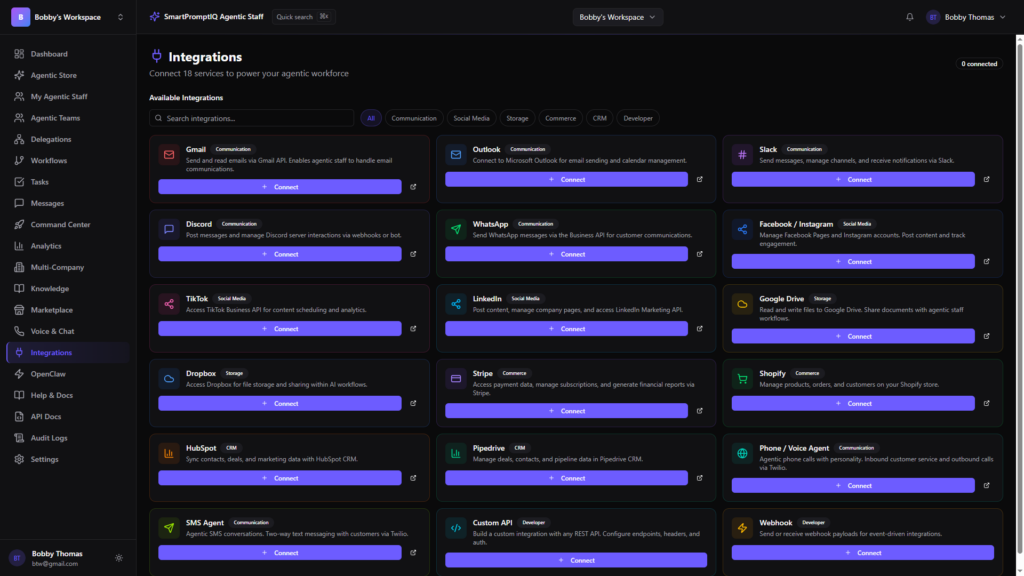
Reading about automation is one thing; actually implementing it is another. The biggest hurdle most business owners face is the perceived technical complexity. They assume that building these automated workflows requires a team of developers and a massive budget.
This is where SmartPromptIQ changes the game. Designed specifically for founders and teams who want to leverage AI without writing code, SmartPromptIQ provides a centralized platform to build, manage, and scale your AI operations.
Step 1: Start with the Right Prompts
Automation fails when the AI does not understand exactly what you want it to do. SmartPromptIQ features a Smart Prompt Generator that asks you context-aware questions and produces production-ready prompts. Whether you need an agent to handle customer support or draft SEO outlines, you start with expert-level instructions.
Step 2: Use Pre-Built Blueprints
With the BuilderIQ feature, you do not have to design workflows from scratch. You simply describe the manual task you want to eliminate in plain English, and the platform generates a complete blueprint for the automation.
Step 3: Deploy and Monitor
Once your AI agent is configured, deploying it is as simple as copying an embed code or connecting an API key. You can monitor its performance through the platform’s analytics dashboard, ensuring that your new “AI staff” is performing exactly as expected.
The Cost of Inaction
The business landscape in 2026 is unforgiving to inefficiency. When your competitors are using AI to handle data entry, customer support, and marketing, they have significantly lower overhead and faster execution speeds. If you continue to rely on manual labor for these 7 tasks, you are artificially capping your growth potential.
Automation is no longer about cutting corners; it is about elevating human potential. By offloading the repetitive, mundane tasks to AI, you free yourself to do the work that actually matters: building relationships, refining your product, and driving strategic growth.
Stop acting like a human router. Reclaim your time, scale your operations, and build your automated workforce today with SmartPromptIQ.