AI ComplianceAI StaffRegulated WorkflowsAI Audit LogsAI Workflows

Artificial intelligence is transforming how businesses operate — but in regulated industries, transformation without accountability is a recipe for disaster. As autonomous AI staff take on increasingly critical roles in finance, healthcare, legal, and human resources, the question of who is responsible when an AI makes a decision has moved from philosophical debate to urgent regulatory requirement.
The answer lies in audit-logged AI actions — a system in which every decision, data access, and output generated by an AI agent is recorded in an immutable, time-stamped log. This is not merely a best practice. In 2026, it is the foundation of responsible AI deployment in any regulated environment.
1. Understanding Audit-Logged Actions
An audit log is a chronological record of all activities performed within a system. In the context of AI agents, an audit-logged action captures not just what the agent did, but why it did it — the input it received, the reasoning it applied, the tools it called, and the output it produced.
Unlike traditional software logs that record system events (errors, logins, API calls), AI audit logs capture decision-level transparency. For example, if an AI finance agent approves a $50,000 wire transfer, the audit log records the exact data points the agent analyzed, the rule set it applied, the confidence score of its decision, and the timestamp of every step. This creates a complete chain of evidence that can be reviewed by compliance officers, regulators, or legal counsel at any time.
“Explainability is not optional for AI in regulated industries — it is the price of admission.” — Gartner AI Research, 2026
2. Importance in Regulated Industries

Regulated industries operate under strict frameworks that mandate accountability for every consequential decision. When AI agents enter these environments, they inherit those accountability requirements. The stakes are significant across several key sectors.
| Industry | Governing Regulation | AI Audit Requirement |
|---|---|---|
| Finance & Banking | SOX, Dodd-Frank, Basel III | Full decision trail for all automated transactions |
| Healthcare | HIPAA, FDA AI/ML Guidance | Patient data access logs + clinical decision records |
| Legal Services | ABA Model Rules, GDPR | Document access, drafting history, privilege logs |
| Human Resources | EEOC, OFCCP | Bias-free hiring decision documentation |
| Real Estate | RESPA, Fair Housing Act | Valuation methodology and data source records |
According to a PwC Global AI Regulatory Survey, 74% of financial services executives cited “lack of AI explainability” as their primary barrier to broader AI adoption. Audit logging directly removes this barrier by providing the documentation regulators demand. For businesses in the trading and investment sector, platforms like SmartProTradeIQ are already building audit-first architectures into their AI trading agents to meet SEC and FINRA requirements.
Compliance Risk: The EU AI Act (2026) classifies AI systems used in credit scoring, employment, and critical infrastructure as “high-risk,” requiring mandatory audit logs, human oversight mechanisms, and regulatory registration. Non-compliance carries fines of up to €30 million or 6% of global annual revenue.
3. How SmartPromptIQ Ensures Compliance
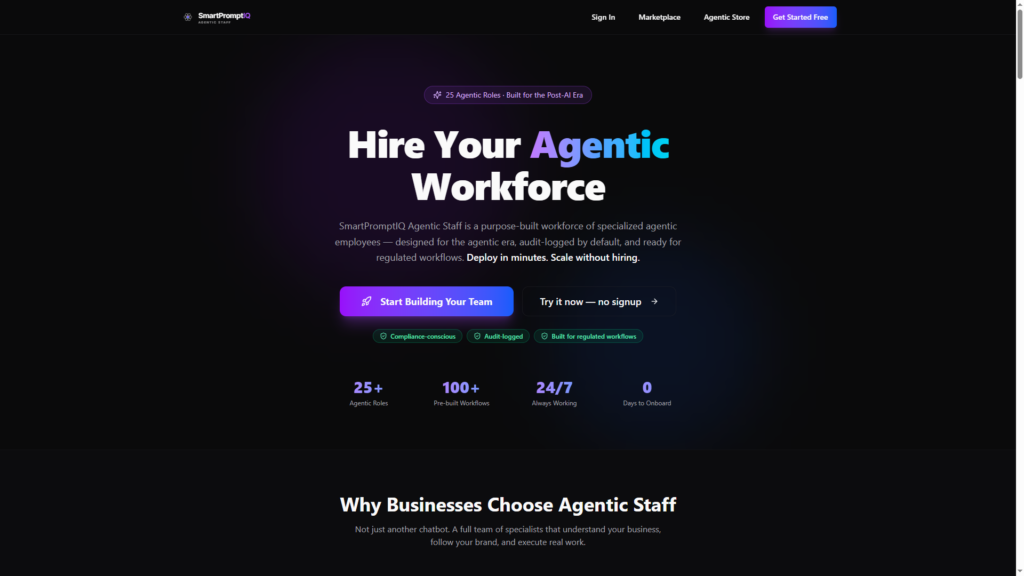
The SmartPromptAgents marketplace is built on a compliance-first architecture. Every AI agent deployed through the platform operates within a structured logging framework that automatically captures the full decision chain for every action taken.
This means that when an AI staff member processes a customer refund, drafts a contract clause, or executes a financial workflow, the system records the triggering input, the agent’s reasoning process, every external API call made, the final output, and the human approval status (if HITL is enabled). These logs are stored in tamper-proof, encrypted storage with role-based access controls.
Furthermore, the SmartPromptIQ Academy trains professionals on how to design AI workflows that are inherently auditable — building compliance into the prompt architecture itself rather than bolting it on as an afterthought. This approach, known as Compliance-by-Design, is rapidly becoming the industry standard for regulated AI deployments.
SmartPromptIQ Compliance Features: Immutable action logs · Role-based access control (RBAC) · Human-in-the-Loop approval gates · Encrypted audit storage · Exportable compliance reports · Real-time anomaly alerts
4. Case Studies of Audit-Logged AI
Case Study 1: AI-Assisted Loan Underwriting
A regional bank deployed an AI underwriting agent to process personal loan applications. Regulators required that every approval or denial be explainable under the Equal Credit Opportunity Act (ECOA). With audit logging enabled, the bank could produce a complete decision report for any application within seconds — showing exactly which data points influenced the outcome and confirming that no protected characteristics were used. The result: zero regulatory findings in two consecutive annual audits. According to McKinsey’s AI in Financial Services report, banks using explainable AI models reduced compliance review time by 65%.
Case Study 2: AI Workflow Automation in Healthcare
A healthcare network used AI agents to automate prior authorization requests — a notoriously slow, paper-heavy process. By implementing audit-logged AI workflows, every patient data access was recorded, every authorization decision was documented, and every exception was flagged for human review. The network achieved a 40% reduction in authorization processing time while maintaining full HIPAA compliance. For professionals looking to replicate this model, SmartProTradeIQ Net offers frameworks for building audit-ready AI workflows across regulated sectors.
5. Implementation Best Practices
Deploying audit-logged AI in a regulated environment requires deliberate architecture decisions from the outset. The following best practices ensure your AI workflows are both effective and defensible.
1
Define Your Logging Scope Before DeploymentIdentify which agent actions require audit logging based on your regulatory obligations. Not every action needs the same level of documentation — focus on consequential decisions that affect customers, finances, or legal standing.
2
Implement Immutable Log StorageAudit logs must be tamper-proof. Use write-once storage solutions and cryptographic hashing to ensure that logs cannot be altered after the fact. This is a non-negotiable requirement for most financial and healthcare regulators.
3
Enable Human-in-the-Loop Gates for High-Risk ActionsFor decisions above a defined risk threshold, require human approval before the AI agent executes. This creates a clear accountability boundary and ensures that a human remains responsible for the most consequential outcomes.
4
Conduct Regular Log AuditsDo not wait for a regulator to review your logs. Schedule quarterly internal audits to verify that your logging is complete, accurate, and accessible. Use resources like SmartDealsIQ to find cost-effective compliance monitoring tools that integrate with your AI stack.
6. Conclusion
Autonomous AI agents are powerful precisely because they act independently. But in regulated industries, independence without accountability is a liability. Audit-logged AI actions transform this liability into a competitive advantage — giving businesses the confidence to deploy AI at scale while maintaining the transparency that regulators, customers, and partners demand.
The businesses that will lead their industries in the next decade are those that treat compliance not as a constraint on AI adoption, but as the architectural foundation upon which trustworthy AI is built. With the right platform, the right training, and the right workflows, audit-ready AI is not just achievable — it is the new standard.
Whether you are deploying your first AI agent or scaling an existing digital workforce, building audit logging into your architecture from day one is the single most important step you can take to ensure long-term success in a regulated environment.
Deploy Compliant AI Staff Today
Every SmartPromptIQ AI agent comes with built-in audit logging, RBAC controls, and compliance-ready workflows — out of the box.
Try SmartPromptIQ AI Staff freeDownload 50 AI Staff workflows