By SmartPromptIQ Team | June 2026
The Evolution from Software to Staff
If you are still trying to solve operational bottlenecks by buying more software subscriptions, you are playing a game that ended in 2024. The modern enterprise landscape has fundamentally shifted. We are no longer adopting passive tools that require human operators; we are deploying AI agents for business that execute complex workflows autonomously.
According to recent industry forecasts, the global market for autonomous digital workers is expected to surge past $11 billion this year alone, driven entirely by companies realizing that scaling revenue no longer requires scaling human headcount. The transition from “software as a service” to “agents as a service” is reshaping every department, from marketing to finance.
In this comprehensive guide, we will break down exactly what AI agents for business are, how they differ from the chatbots of the past, and how you can integrate them into your operations using the SmartPromptIQ ecosystem to drive unprecedented efficiency.
What Exactly Are AI Agents for Business?
To understand the impact of this technology, we must clarify the terminology. An AI chatbot (like early versions of ChatGPT) is a conversational interface. You ask it a question, and it gives you an answer. It is reactive.
An AI agent is proactive and autonomous. It is given a goal, a set of tools, and the authority to make decisions to achieve that goal. When we talk about AI agents for business, we are talking about specialized digital entities designed to function as employees.
For example, an AI SEO Agent does not just write a blog post when asked. It autonomously monitors your website’s search rankings, identifies a keyword gap, researches competitors, generates a content brief, writes the article, and formats it for publishing. It executes a multi-step, cross-functional workflow without requiring a human to prompt it at every stage.
The Economics of the Agentic Workforce
The primary driver behind the explosive adoption of AI agents for business is pure economics. The traditional model of business growth is linear: to get more output, you must hire more humans or buy more software licenses. Both increase your overhead significantly.
| Metric | Traditional Hiring | AI Agents for Business |
|---|---|---|
| Onboarding Time | 3 to 6 months | Instant (Minutes) |
| Availability | 40 hours/week | 24/7/365 |
| Cost Scaling | Linear (High overhead) | Flat or Marginal (Low overhead) |
| Workflow Execution | Prone to human error | Consistent and audit-logged |
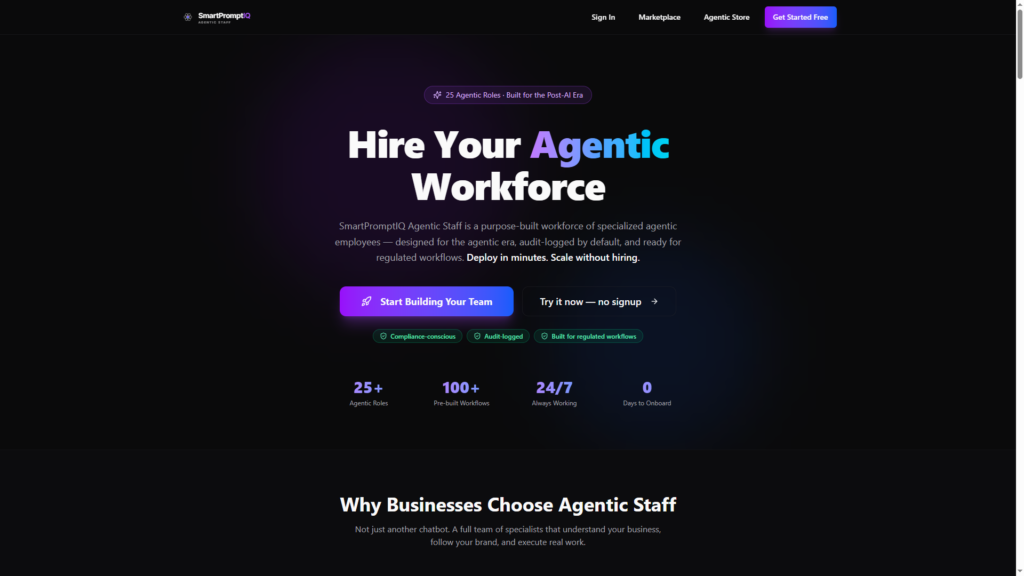
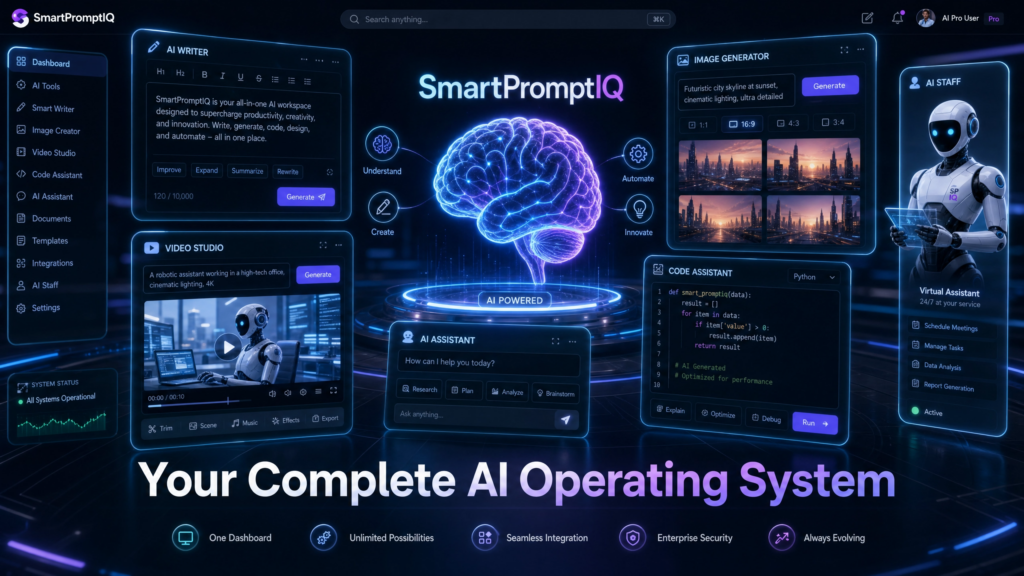
By deploying an autonomous workforce, businesses decouple revenue growth from headcount. A 10-person agency can suddenly output the work of a 50-person agency. This is where platforms like SmartPromptIQ AI Staff become indispensable. Rather than spending months recruiting and training a junior marketing manager, you can instantly deploy a pre-trained digital marketing agent that understands your brand voice and executes campaigns flawlessly.
How to Deploy AI Agents Across Your Departments
The most successful companies do not just use AI agents for business in one isolated department; they weave them throughout their entire operational fabric. Here is how specialized agents are transforming core business functions.
1. Marketing and Lead Generation
Marketing departments are traditionally bogged down by repetitive tasks: formatting newsletters, scheduling social media posts, and building lead lists. An AI agent takes over these execution tasks. You set the strategic goal—”Increase inbound leads by 20% this quarter”—and the agent handles the daily execution of A/B testing ad copy, optimizing landing pages, and routing qualified leads to your sales team.
2. Operations and Customer Support
Customer support is the perfect testing ground for autonomous agents. Instead of relying on a frustrating decision-tree chatbot, modern support agents can access your entire knowledge base, read a customer’s purchase history, and autonomously issue refunds or process returns based on your company policies. They resolve tickets end-to-end, escalating only the most complex emotional issues to human managers.
3. Financial Analysis and Strategy
In highly specialized fields like finance, the impact of AI agents is even more profound. We are seeing a massive shift away from complex charting software toward autonomous analytical agents. For example, platforms like SmartProTradeIQ utilize AI coaching agents that autonomously analyze market trends, backtest strategies, and provide real-time, actionable insights to traders—effectively replacing both legacy software and human analysts.
The Power of the Agent Marketplace
One of the greatest barriers to adopting AI agents for business has traditionally been the technical complexity of building them. If you had to code an autonomous workflow from scratch using Python and API keys, only enterprise tech companies could afford to play the game.
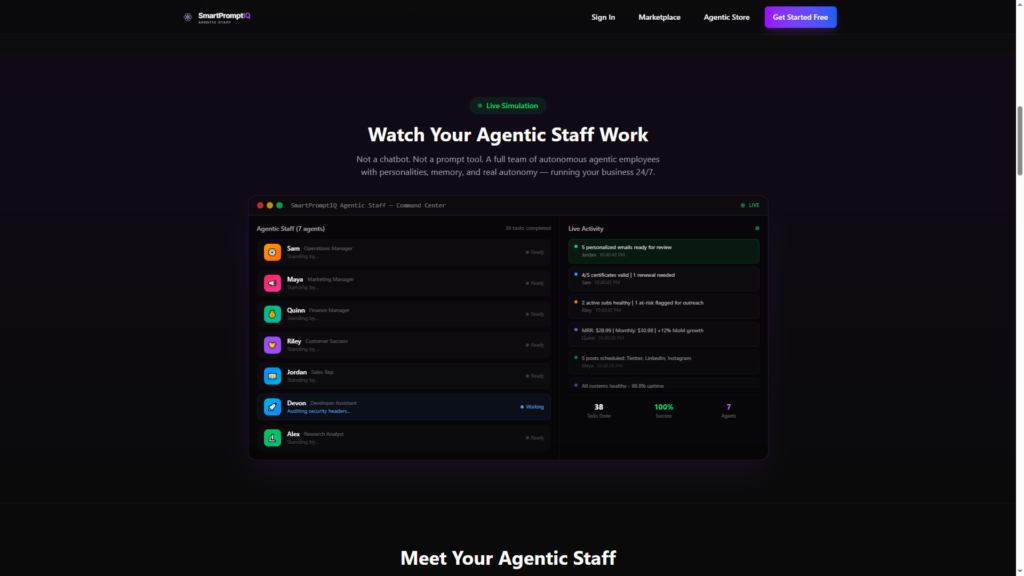
This barrier has been completely shattered by the rise of community-driven marketplaces. When you leverage ecosystems like SmartPromptAgents, you gain access to a library of pre-built, proven agent configurations.
If another company has already perfected an AI agent that handles complete e-commerce onboarding, you do not need to rebuild it. You simply download that agent’s blueprint, install it into your workspace, tweak the brand voice, and launch. This democratization of AI technology means that small businesses now have access to the exact same operational power as Fortune 500 enterprises.
Managing Your New Digital Workforce
The transition to an agentic enterprise requires a shift in human management skills. Your human employees are no longer “doers” of repetitive tasks; they must become “managers” of digital workers.
This means your team must learn how to design workflows, establish clear guardrails, and audit the output of AI agents. The best AI platforms include “Human-in-the-Loop” features, allowing human managers to review and approve high-stakes actions before the agent executes them. This ensures compliance and quality control while still benefiting from the massive speed of AI execution.
Prompt Engineering: The New Management Skill
There is a critical skill that separates businesses that get mediocre results from AI agents and those that get extraordinary results: prompt engineering. Prompt engineering is the art and science of communicating with AI systems in a way that consistently produces high-quality, reliable outputs.
Think of it as the management language of the agentic era. Just as a great human manager knows how to brief a team clearly, delegate with precision, and set measurable expectations, a great AI manager knows how to write prompts that give their digital workers the exact context, constraints, and goals they need to succeed.
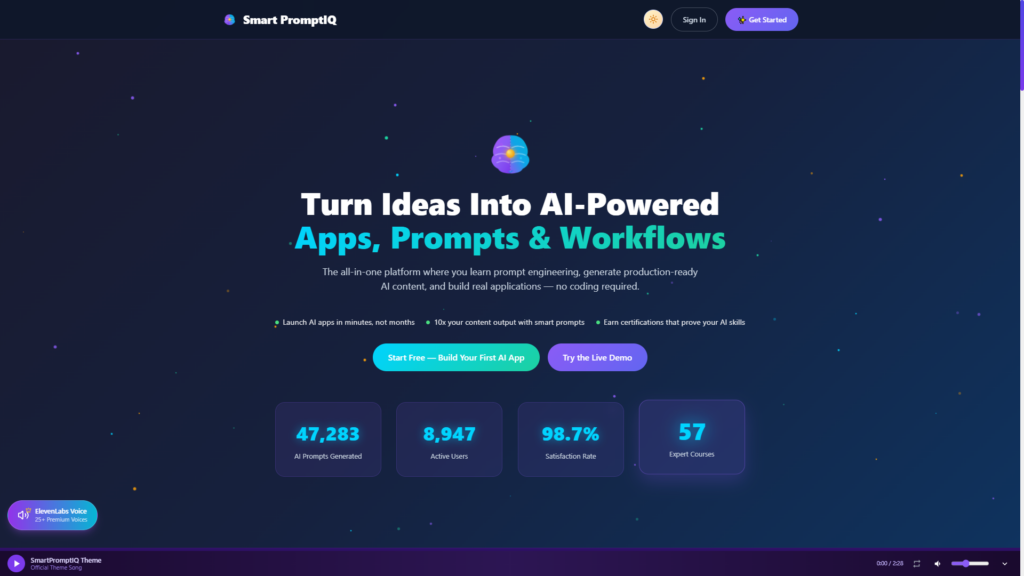
The good news is that you do not need a computer science degree to master this skill. Platforms like SmartPromptIQ are specifically designed to democratize prompt engineering. Their Academy provides structured training that takes you from basic prompt writing to advanced multi-agent orchestration, ensuring that your human team can manage your digital workforce with maximum effectiveness.
According to Grand View Research, the global prompt engineering market is projected to grow from $222 million in 2023 to over $2 billion by 2030. This explosive growth signals that prompt engineering is not a niche technical skill; it is becoming a core business competency.
AI Workflows: The Operating System of the Modern Business
Individual AI agents are powerful, but the real magic happens when you connect them into AI workflows. A workflow is a sequence of automated steps where the output of one agent becomes the input for the next. This creates a fully autonomous assembly line for your business operations.
Consider a complete content marketing workflow: an AI Researcher identifies trending topics in your niche and compiles a brief. That brief is automatically passed to an AI Content Writer, who produces a full 1,600-word article. The article is then reviewed by an AI Copy Chief for brand voice consistency, and finally formatted and scheduled for publishing by an AI Admin Assistant. The entire process runs without a single human touchpoint.
These interconnected AI workflows represent the new operating system of the modern business. Companies that build robust, automated workflow systems will operate at a speed and efficiency that manually operated competitors simply cannot match. According to McKinsey’s research on generative AI, businesses that successfully automate cross-functional workflows see productivity gains of up to 40% within the first year of deployment.
Compliance, Trust, and the Human-in-the-Loop
One of the most common concerns business owners raise about deploying AI agents is the question of control. What happens if an agent makes a mistake? How do you ensure that your brand voice is maintained? How do you stay compliant in regulated industries?
The answer lies in the Human-in-the-Loop architecture that the best AI platforms are built around. Rather than running fully autonomously with zero oversight, enterprise-grade AI agents are designed with approval checkpoints. High-stakes actions—like sending a client proposal, publishing a press release, or executing a financial transaction—are flagged for human review before the agent proceeds.
Furthermore, every action taken by every agent is logged with a complete audit trail. This means that if something goes wrong, you can trace exactly what happened, when it happened, and which agent was responsible. This level of transparency and control is actually superior to managing human employees, where mistakes are often undocumented and difficult to trace.
The Future is Agentic
The adoption of AI agents for business is not a future trend; it is the current reality of competitive enterprise. The companies that thrive over the next five years will be those that successfully integrate autonomous digital workers into their daily operations, freeing their human talent to focus on creativity, strategy, and relationship building.
Do not wait until your competitors have already scaled their output tenfold. The tools to build your autonomous workforce are available, accessible, and ready to deploy today.
Ready to Scale Your Operations?
Stop hiring for repetitive tasks. Start building your autonomous digital workforce today.
Try SmartPromptIQ AI Staff freeDownload 50 AI Staff workflows