In the hyper-competitive business landscape of 2026, reacting to trends is no longer enough. If you are waiting for a trend to hit the mainstream news, appear on your social media feed, or show up in an industry report, you are already too late. The early adopters have captured the audience, secured the lowest customer acquisition costs, and established themselves as market authorities.
Historically, the ability to see around corners and predict market shifts was a luxury reserved for Fortune 500 companies. They employed armies of data scientists, utilized expensive synthetic data platforms, and spent millions on consumer behavior modeling. For solo founders and small businesses, trend spotting was largely based on intuition, networking, and a bit of luck.
Today, that paradigm has fundamentally shifted. Artificial Intelligence has democratized predictive analytics. According to the Small Business & Entrepreneurship Council, 2026 marks the year where small businesses are moving beyond simple AI experimentation and are actively building sophisticated “AI stacks” . By deploying AI as a dedicated “Trend Scout,” small businesses can now analyze billions of data points in real-time, predict consumer behavior months in advance, and uncover highly profitable niche markets before their competitors even know they exist.
Here is how you can transform your business from reactive to predictive using AI platforms like SmartPromptIQ.
The Evolution of Market Intelligence: From Reactive to Predictive
To appreciate the power of an AI Trend Scout, we must first examine why traditional market research is failing modern businesses.
Traditional research relies on surveys, focus groups, and historical sales data. This approach is inherently flawed because it is backward-looking. It tells you what consumers wanted yesterday. Furthermore, human analysts can only process a tiny fraction of the data generated daily on the internet.
AI, on the other hand, operates on a massive scale and focuses on the future. Predictive analytics models have moved from data science experiments into operational business functions . These models continuously analyze real-time data — search volumes, foot traffic, social sentiment, macroeconomic indicators, and competitor pricing — to generate actionable forecasts.
Here are the three core ways AI acts as a Trend Scout for your business:
1. Predicting Consumer Behavior with Synthetic Data
One of the most significant breakthroughs in 2026 is the use of synthetic data to model consumer behavior. Platforms can now simulate how specific demographic groups will react to new products, pricing changes, or marketing campaigns before they are even launched .
Instead of broadly targeting “millennials,” an AI Trend Scout can identify micro-segments — for example, “tech executives who prefer eco-friendly boutique hotels with co-working spaces” . By tracking digital interactions alongside physical foot traffic, AI provides a comprehensive view of where your customers are and what they will want next. This allows small businesses to allocate their limited marketing budgets with laser precision.
2. Hyperlocal Demand Forecasting
For retail, e-commerce, and service-based businesses, geographic trends are crucial. AI tools now process billions of daily search queries to predict demand trends up to 12 months in advance, often with over 95% accuracy .
Imagine knowing that demand for a specific product category is going to spike in the Pacific Northwest three months before it happens. An AI Trend Scout can organize keywords into custom geographic dashboards, highlighting exactly which social platforms (TikTok, LinkedIn, Reddit) are driving the conversation in those specific regions . This foresight enables you to optimize inventory, tailor your ad spend, and establish a local presence before the competition catches on.
3. Real-Time Competitor Anomaly Detection
While you are sleeping, your AI Trend Scout is watching your competitors. Advanced AI systems do not just track competitor websites; they look for anomalies and patterns.
If a competitor suddenly increases their ad spend by 40% in a new geographic market, or if they quietly update their API documentation to support a new integration, the AI flags these movements immediately. This real-time intelligence allows you to deduce their strategic roadmap and counter their moves weeks before they officially announce their new initiatives.
The “Early Mover” Financial Advantage
The ROI of AI trend forecasting is concrete and measurable. Small businesses are not just adopting AI for efficiency; they are using it as a direct driver of revenue growth .
When you predict a trend early, you unlock the Early Mover Advantage, which impacts your bottom line in three distinct ways:
| Business Area | The AI Early Mover Advantage | The Cost of Being Late |
| Customer Acquisition | Bid on emerging keywords while CPC (Cost Per Click) is pennies. | Pay premium rates to compete against dozens of established rivals. |
| Product Positioning | Launch solutions into an underserved market, capturing high margins. | Enter a saturated market where you must compete on price alone. |
| Inventory & Supply Chain | Adjust inventory based on predictive demand, avoiding stockouts. | Lose sales due to lack of supply, or tie up capital in obsolete stock. |
In the retail sector, for example, businesses utilizing AI predictive analytics have seen a 21% improvement in demand forecasting accuracy . In the SaaS industry, predictive models identifying early churn signals have recovered millions in retention value . The math is simple: the faster you identify the trend, the higher your profit margin.
Building Your AI Stack: The SmartPromptIQ Approach
According to recent data, the average small business in 2026 uses a median of five AI tools, creating a “stack” that serves different functions across the enterprise . However, managing five disjointed subscriptions can lead to software fatigue and fragmented data.
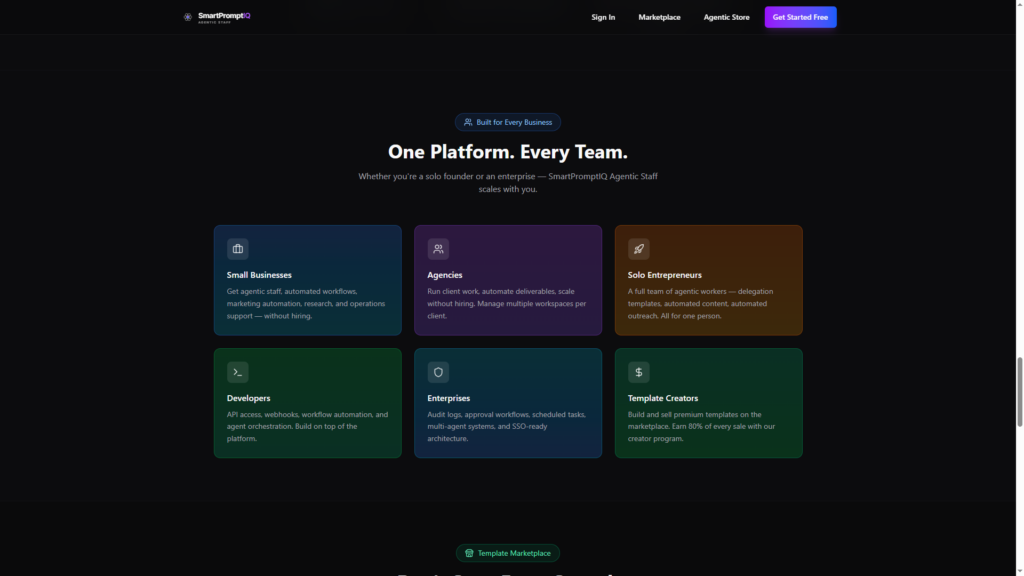
This is where SmartPromptIQ becomes the ultimate competitive weapon. SmartPromptIQ acts as the central hub of your AI stack, allowing you to deploy intelligent agents that handle your trend scouting autonomously.
Here is how you can build a predictive intelligence engine using SmartPromptIQ:
Step 1: Deploy the “Competitor Watchtower” Agent
Using SmartPromptIQ’s intuitive dashboard, you can configure an AI agent to monitor your top five competitors continuously. Instruct the agent to track their content output, pricing changes, and social media engagement. Every week, the agent will deliver a synthesized intelligence brief directly to your inbox, highlighting any strategic shifts or emerging threats.
Step 2: Automate Niche Discovery and Content Gaps
Do not waste time brainstorming content ideas manually. Use the Smart Prompt Generator to instruct your AI to analyze industry search trends and identify “content gaps” — high-intent topics that your competitors have completely missed. The AI will not only find the trend but can also generate a comprehensive content outline designed to rank on Google before the topic becomes saturated.
Step 3: Predictive Customer Retention
If you run a subscription or service business, your Trend Scout should also look inward. You can connect SmartPromptIQ to your CRM and instruct the AI to analyze customer engagement patterns. The AI can identify the subtle behavioral shifts that precede customer churn — often weeks before the customer actually cancels . Once a high-risk customer is identified, SmartPromptIQ can automatically trigger a personalized retention email, saving the account without any manual intervention.
Step 4: Rapid Go-to-Market Execution
Identifying a trend is only half the battle; execution is everything. When your Trend Scout uncovers a new market opportunity, use SmartPromptIQ’s Voice AI Studio and content generation tools to rapidly deploy marketing assets. You can spin up landing page copy, social media videos, and email campaigns in hours instead of weeks, securing your early mover advantage.
The Cost of Ignoring the Future
The adoption of AI among small businesses is no longer a slow curve; it is a rapid acceleration. Over 82% of small business employers have already invested in AI tools, and 93% of those users plan to continue or increase their investment in the coming year .
If your business is still relying on reactive market research, manual competitor analysis, and gut instinct, you are operating at a severe disadvantage. The companies that are thriving in 2026 are those that have embraced the shift from reactive dashboards to predictive, automated workflows .
The “Trend Scout” is no longer a human analyst sitting in a corporate office. It is an intelligent, tireless, and highly accurate AI agent working for you 24/7.
Stop reacting to the market. Start predicting it. Empower your business with the predictive intelligence of an enterprise corporation by building your AI workforce with SmartPromptIQ.